Eight years ago, Dillon Smith was a sophomore at a Bible college, getting a degree in pastoral ministry, with no particular interest in business.
Today, he’s the fractional CMO behind some of the most influential church platforms in the world — and the founder of CMO.Church, a firm built on the conviction that world-class marketing should be available to every pastor and church on the planet.
What happened in between is the story of this episode.
Dillon spent years working behind the scenes for Carey Nieuwhof — as his executive assistant, then as content manager sending daily emails to 60,000 pastors. Then came Life.Church, where he ran Craig Groeschel’s Leadership Podcast and the Life.Church Open Network. Then, in June 2025, he stepped out on his own.
He didn’t just learn marketing along the way. He learned something harder to teach: how to know when it’s time to go, how to carry what you built into something new, and whether you’re building for the right kingdom.
In This Conversation, Dillon Smith Shares:
👉 Why your passion often moves before your calling does — and what to do with that
👉 Three markers that helped him know it was time to leave Life.Church
👉 Why nothing from your ministry past is wasted — even the seasons that made no sense
👉 What he learned from Carey Nieuwhof and Craig Groeschel that still shapes how he works
👉 The dangerous trap of building a platform just to be famous for being a good Christian
👉 What “check writers” are willing to pay for — and why that’s the right place to start
👉 Why community is what content was in the 2010s
👉 The Second Mountain — and whether you’re building the kingdom of me
What a Healthy Eight Taught Him
One of the first things Dillon says about working for Carey Nieuwhof is that Carey is a strong Enneagram Eight. A healthy one. And healthy Eights, Dillon has found, are advocates — not just for you, but for the best version of you.
In those first six months, he could have been fired multiple times. He missed deadlines. He showed up late. By any reasonable standard, Carey would have been justified in cutting him loose.
“He showed way more grace than the average leader. And he’s one of the most hard-charging, strong, impactful ministry leaders on the planet. Those two things can live in tension together.”
The principle Carey installed in those early months still drives how Dillon works: do what you say you’re going to do, when you say you’re going to do it. Simple. Non-negotiable. And, Dillon says now, just the floor.
“Eight years into a marketing career — that’s bare minimum. If you want to be great at anything, that’s just the base layer.”
My Passion Moved Two Years Before My Calling Did
The central insight of this episode — and the one Dillon says he didn’t fully understand while it was happening — is this:
“My passion moved two years before my calling did.”
He loved Life.Church. He woke up every morning energized by the mission of getting free resources into the hands of more pastors. But at night, he was watching Alex Hormozi on YouTube. Reading business books. Getting pulled toward a world he’d never been interested in before.
It felt strange. A little suspect. He even names the sermon that made him wonder: Ashley Wooldridge preached at Life.Church on the spirit of mammon. Dillon listened carefully.
“I identified this very easily could be that. And the question is, how do you keep it pure and not that?”
His answer: watch what you’re willing to give away. Several of his current clients, he invests in at a loss — not because they pay well, but because he believes in their mission. For Dillon, that’s the tension management. If it’s still kingdom passion at the bottom of the motivation, the move is clean.
Three Signs It Might Be Time
When Dillon looks back at his transition out of Life.Church, he points to three markers that helped him know the timing was right:
First, his passion had already moved. Not away from the mission — but toward something new. The YouTube videos at night were a signal worth taking seriously.
Second, he’d given everything he could to the role he was in. “The podcast was set up to keep growing. Lead magnets were in place. Systems and team members were there. Anything I would have done by staying, I’d just be saying the same things again for incremental results.”
Third, the math worked. He didn’t leave until he had 133% of his Life.Church salary in recurring freelance contracts. A mentor gave him the rule: don’t quit your job until you have something to jump to.
Nothing From Your Past Is Wasted
Inside Carey’s Art of Leadership Academy, Dillon knows a pastor who spent 20 years as a college professor and two years grinding through financial spreadsheets in a research department. He couldn’t figure out why. He felt called to people, to ministry. Why was God parking him in data?
Then he stepped into a campus pastor role at his church. Nobody had been watching the finances. The church had months left before running out of money. His first three months on staff: all spreadsheets.
“There’s where God was using that.”
Very rarely, Dillon says, does a leader living out their calling look back and say a season was wasted. If it hasn’t made sense yet, it’s probably for something still ahead.
“When you look back at your past, if you don’t see it yet — why you were there — it probably means it’s for something in your future.”
Build Something Real Before You Build a Platform
Both Carey and Craig, he explains, would tell you to build the thing first and let the platform follow. Craig didn’t set out to build a platform when he started Life.Church. It grew into one of the fastest-growing churches in America. The platform showed up as a result.
Dillon is direct about the risk of doing it the other way:
“I look back at 17-year-old Dillon and I had a massive problem with idolatry of self — wanting to be on the big stages, wanting to have the platform.”
“I hope people follow me because they want to figure out how to do marketing well. What’s the other thing that people follow you for — not just because you’re a pastor or because you can say really cool bottom lines in your message hooks?”
The challenge: what would you build even if it never produced a platform? What problem can you solve that someone would actually pay for?
Start With the Check Writers
The practical answer to that question, in Dillon’s experience, is to go to a few people — friends, colleagues, anyone around you with real problems to solve — and tell them you have a little bit of capacity.
Not just people. Check writers. People who are willing to pay for a service. What they say yes to is your market validation.
For Dillon, that feedback converged around two things: growing podcasts and marketing strategy. He eventually realized that’s what he’d been doing as a fractional CMO at Life.Church and Carey’s team for years.
“You might be really good at social media. You might be really good at team building, culture building. Maybe you just need to tell some people you have a little bit of extra capacity and see what they’re willing to pay you for.”
He credits that framework to Casey Stanton’s book The Fractional CMO Method.
The House Always Wins on Social Media
A useful reality check from someone who’s built some of the largest church platforms in the country:
“By default, the house wins. They will get more value out of you than you will out of them 99% of the time.”
Life.Church grew every channel by prioritizing impressions and growth. That worked — because Life.Church has 45 campuses across the country, and one specific CTA doesn’t make sense for them. But for anyone building a business or a ministry, the CTA matters. Getting people off the platform and into something you own — email, text, a community — is the move.
Carey’s line from 2018 still holds, even if the tools have shifted: he’d rather have a thousand email addresses than 10,000 Instagram followers. Dillon’s current take: text marketing is the version of that right now. And more than anything, the fastest path to a real relationship isn’t a funnel — it’s a dialogue.
“The minute somebody follows you, message them. Start a conversation. Churches should do this too — the minute someone follows you, have someone on your campus team message them and just ask, how’d you find out about us?”
Community Is What Content Was
One of the larger arguments Dillon makes in this episode:
“Community is what content was in the 2010s. I think community will be in the 2025s through 2035s what content was in the 2010s.”
As access to information has multiplied — you can listen to the best preachers in the world anytime, anywhere — content alone becomes less differentiated. The hunger is for connection. Belonging. Real interaction.
That’s part of why Carey doubled down on his Academy. It’s why Dillon built a School community for CMO.Church. And it’s why, for anyone starting to build something: a community around a shared question may be a more durable foundation than a content library.
The starting questions are simple: what platform will you use to gather people, and what topic would you show up to talk about every day — even if it never made any money?
The Metric That Actually Matters
Most creators obsess over followers and impressions. Dillon tracks something different: lead magnet conversion rate.
The principle is straightforward: give people something valuable for free when they join your community or email list. The percentage of people who take that offer — when presented with it on a landing page — is the number to watch.
Industry standard is 20 percent. Dillon’s target is 40 to 60 percent. He calls anything at 40 percent or above a “10 out of 10 lead magnet.”
When he ran Carey’s email list, most lead magnets barely moved the needle. The ones that did were specific and timely. The COVID crisis course — built and launched in two weeks, given away free behind an email opt-in — grew the list by 10,000 people with zero ad spend.
“That’s the most important part of the funnel: how are people joining your ecosystem?”
The Internet *Never Lies
One of Carey’s most useful lines, Dillon says, is this: the internet *never lies.
When something flops, that’s information. When it takes off, that’s information too.
“Your feelings and what you feel like is a good story almost always lies.”
His example: his own origin story used to take 25 minutes to tell. He eventually realized nobody needed that much. Now it’s two minutes of credibility, then the content.
What you love talking about and what people want to hear aren’t always the same thing. The data is feedback. What gets measured gets improved.
The Second Mountain
The most significant moment of this conversation came near the end, when Dillon recommended a book by David Brooks called The Second Mountain.
Brooks was a wildly successful author — then went through a divorce, began a slow encounter with Jesus, and wrote this. The premise:
Everyone climbs two mountains in life. The first mountain is the mountain of self — building the platform, achieving the thing, making a name. Western culture trains us for this. Our sinful nature amplifies it. Most of us spend years here.
Then something knocks us off. A loss, a failure, a season of the in-between. And in the valley, if we’re paying attention, we discover the second mountain.
The second mountain is lived out of commitment to others. Not commitment to self.
Dillon’s message to anyone in a season of transition:
“Make sure you’re off that first mountain. Are you building the kingdom of me or the kingdom of Jesus? Are you living for others, serving others well?”
He was honest about his own history — years of building the kingdom of Dillon, idolizing the platform, wanting the stage. The book, he says, did surgery on his soul. He’ll make everyone he develops read it from now on.
What Flourishing Looks Like
Dillon’s answer to the flourishing question doesn’t land on success or health or peace.
“Am I living out the mission, the calling, the purpose that I would give my life to — and am I heading in that direction? If that’s the case, I think I’m flourishing in a calling, spiritual, eternal-purpose sense.”
He borrows from Carey’s company mission — to reverse the decline of the church in the West — and the posture behind it: “We may never accomplish it. But we’re going to die trying.”
Flourishing, for Dillon, isn’t about hitting goals. It’s about heading toward the thing you’d commit to even if it failed.
For the Leader in Transition
📌 Your passion moving before your calling does isn’t a problem. It’s a signal worth paying attention to.
📌 Nothing from your ministry past is wasted — even the seasons that made no sense yet.
📌 Build something real first. Let the platform follow the work.
📌 The fastest path to a relationship is a dialogue, not a funnel.
📌 The question isn’t just where you’re going. It’s whose kingdom you’re building when you get there.
Questions Worth Asking
- What has your passion been moving toward — even while your role stayed the same?
- Is there a skill or experience from your past that you’ve dismissed but hasn’t fully made sense yet?
- What would you build even if it never produced a platform?
- Are you building the first mountain or the second?
Want to Connect with Dillon?
🌐 Website: cmo.church
📱 Instagram: @dillon_m_smith
🏫 School Community: CMO.Church Growth Accelerator
📚 Books mentioned:
- The Second Mountain by David Brooks
- The Fractional CMO Method by Casey Stanton
- $100M Leads by Alex Hormozi
Not Sure What Comes Next?
Everything Just Changed—Now What?
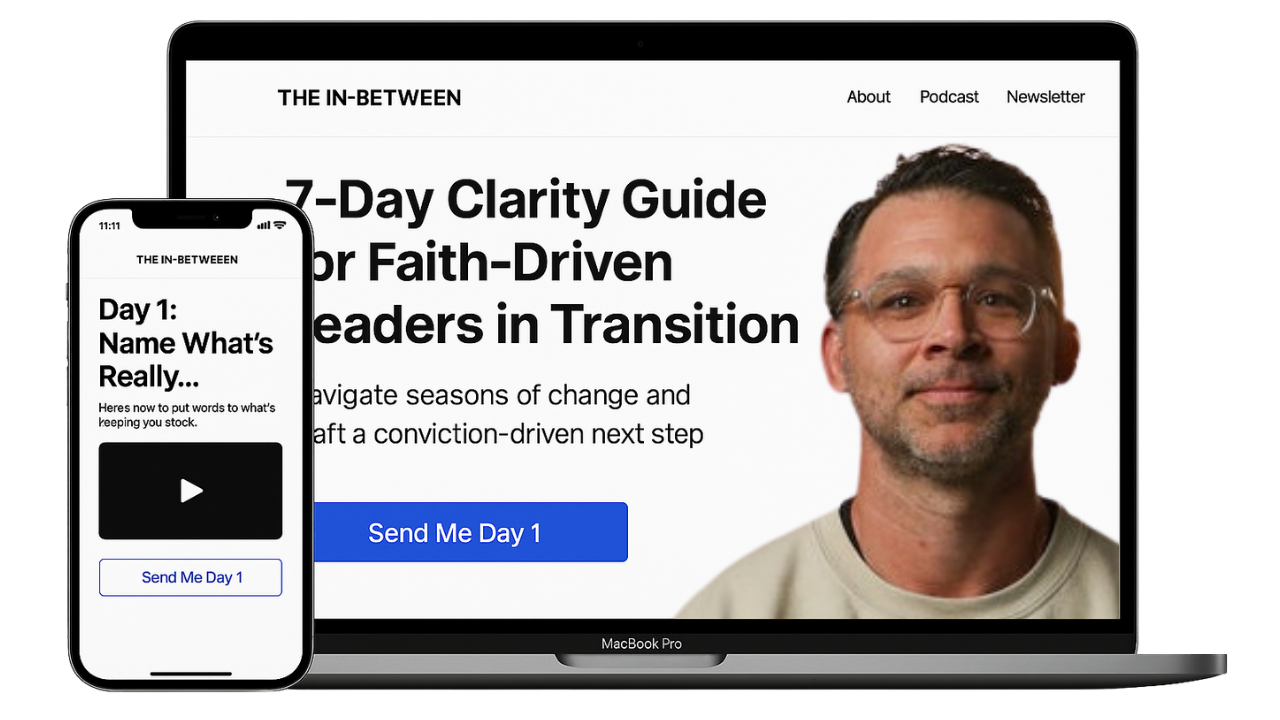
This 7 day email course will help you regain direction, surface your values, and figure out your next step without pressure or pretending to have it all figured out.